Q&A with Vee
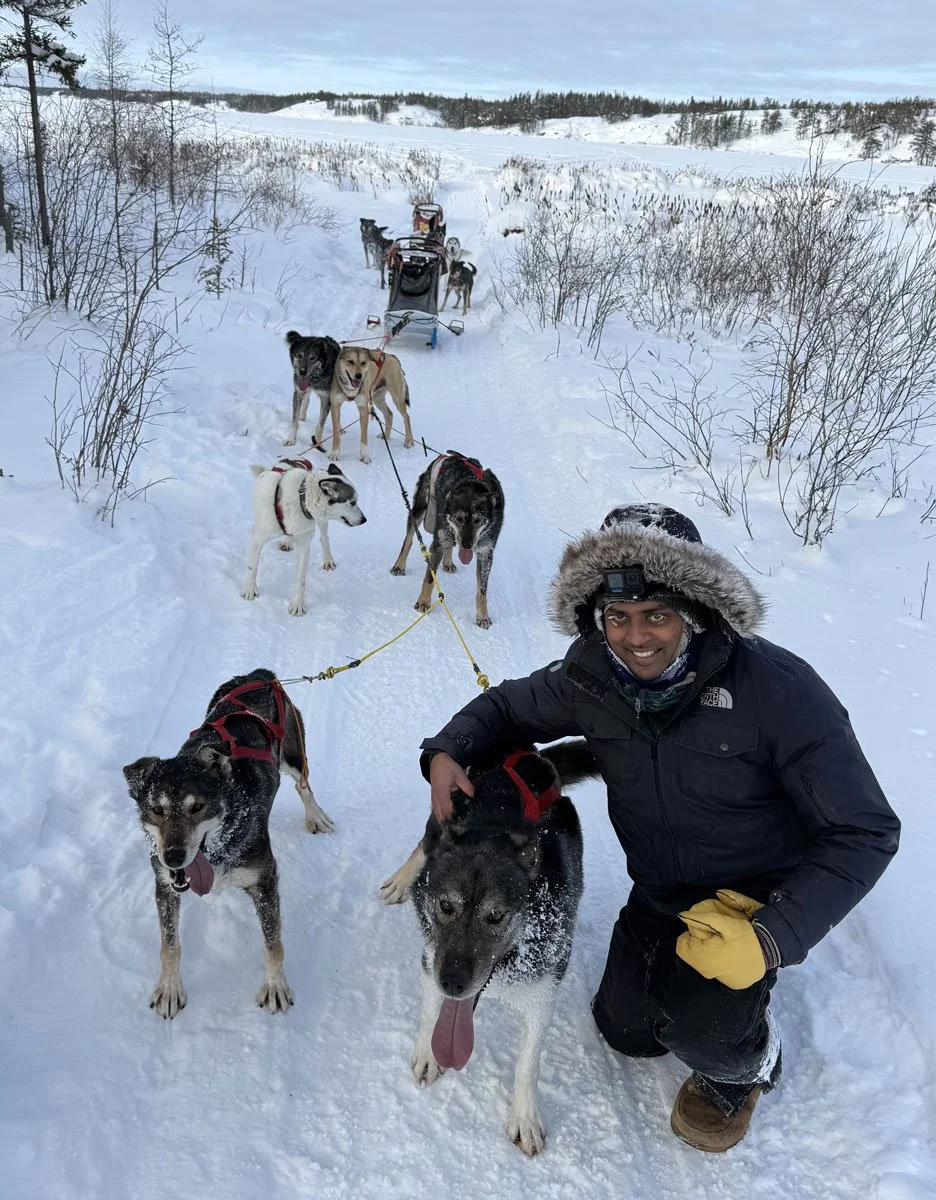
There are people who work with dogs, and there are people to truly understand them. We’ve been lucky to find the latter with our new manager, Vee (Vysakh). Vee has a degree in Business Management, but more importantly, Vee shares much of Lisa’s passion for pet care. Vee especially enjoys northern breeds and has had memorable mushing experiences in the Northwest Territories. Previously, he worked in large, cage-free dog daycares in the GTA and later in Yellowknife, and served as the manager of the Yellowknife SPCA. He is now a full-time, live-on-site manager, teaming up with Lisa to give your dog a fun-filled stay at Happy Tails Pet Resort & Camp.
Since April 1996, Happy Tails has always been a place where dogs can run, play, and explore at a resort made for them. Every one of our furry guests is free from the confinement of a cage and the tug of a leash. Their days are spent on their terms, whether it’s taking a morning swim or running through open spaces in huge, segregated dog parks for their different sizes and behavioural needs. They get to be cottage dogs on vacation, enjoying our many huge, fully fenced parklands, and be like the generations of city dogs who love their cottage dog lifestyle.
That's why when Lisa began speaking with Vee over the course of a few months, it felt like a natural fit to welcome him to our team. His experience includes managing large, cage-free daycares of up to 80 city dogs in both the GTA and Yellowknife. Yes, Yellowknife has Qimmiq, a dog boarding, daycare and grooming facility that also engages in lots of dog sledding activities. And that is where he started his northern adventure.
Like Happy Tails, Qimmiq Kennels hosts international travellers. So, Vee is experienced with meeting lots of different nationalities. My helpers love positive energy, so do my clients and particularly their dogs. And like Happy Tails, Qimmiq Kennels also incorporates huge parks for dogs to group and enjoy cage-free time. The name is derived from the Inuktitut word for "dog," qimmiq.
When the owner sold her business, she recommended Vee to the Yellowknife SPCA, and he transformed the way the Yellowknife SPCA cared for its animals by reimagining how dogs moved through the kennel, reducing hours of cleaning time, and giving dogs a chance to run free beyond their cages. He understands what dogs need when they're together in groups, and he knows how to create an environment where they can be cage-free and happy.
We sat down with Vee to learn more about his story and why he’s a great addition to our team.
Q: You went from kennel assistant all the way to managing the NWT Yellowknife SPCA, quite a journey for someone who has a background in business management. What drew you to animal care?
Vee: I started a job in a dog daycare when I was doing my studies in Kitchener. I was just planning to do it as a part-time job until I finished my studies, but after I started this job, I really liked it. I wanted to learn more about dogs, and especially working dogs. And that totally changed my whole career. The manager was a really experienced person. She was working there for around 30 years, and I learned so many things from her.
After that job, I worked in Toronto at cage-free daycares that housed around 60 to 80 dogs daily. I’d work with large groups of cage-free dogs in large exercise groups.[RC1]
Q: You also have experience working with professional dog mushers in the Northwest Territories. How did you come across this unique opportunity, and what did the work involve?
Vee: I was interested in moving somewhere colder, like somewhere near the Arctic. I got another job opportunity from Yellowknife at a dog daycare that worked with over 100 dogs that visited every day.[RC2] This particular job had another advantage because the owner of that kennel also had a sled dog team.
I moved to Yellowknife and I started working with the sled dogs. I learned so many different things between the house dogs I was working with during the daytime, and sled dogs. Their behaviour or their needs were totally different.
When the owner of that business retired, she recommended me for a job at the Northwest Territories SPCA. They were really short-staffed, and they were struggling financially. I took the job because I also have a degree in business management. I studied that from Canada, so I like to do both. It helps me stick with my career, and it was a big opportunity.
I helped the SPCA reduce the hours they’d spend cleaning kennels by running groups where the dogs were cage-free. It gave the dogs a release, where they could get their energy out and be free.[RC3] I was proud of working for the SPCA because it was one of the only ones for Northwest Territories and Nunavut.
Q: You mentioned that working with sled dogs is completely different. What did the work with the sled dogs involve?
Vee: For sled dogs, in the summer we’re just maintaining – feeding the dogs, letting them have enough workouts, and helping them stay hydrated because they live outside.
In the fall, we start training before it starts snowing. We train the young puppies with the older dogs. In the beginning, the distance will be very short, like 4 miles, and it will gradually increase by every week, like to 13 miles, 26 miles. My boss was an expedition musher, so she had slower dogs [than sprint dogs], but they can go longer distances. Those dogs need to have a different kind of training.
I participated in the sprint sled dog race, six dog category in Fort Providence and Dettah for Richard Beck's racing kennel, Yellowknife in 2024-25 winter.
I also worked as a dog musher in a tour company. In Yellowknife, the sled dog tour is a big thing.
Q: What was it like making the shift from working with sled dogs to dogs at the SPCA?
Vee: At the SPCA, I learned more about a different kind category of dogs which are neglected or very scared. We had to be very careful, because there'll be so many fearful dogs, and dogs who don't trust other dogs, or are extremely aggressive to people.
Q: You're known for "reading" dogs by understanding their energy and group dynamics. Can you walk us through what looks like in a daycare setting? What are you watching for?
Vee: So, the first thing is we do is talk to the people who have the dog. Many people have dogs from rescues or were adopted. Even in daycares, we sometimes have dogs with a lack of confidence or fearful behaviours. It is important to know and understand different dogs need different things.
Q: What's something you hope to bring to Happy Tails as its new manager?
Vee: In my opinion, people like to see more about the activities their dogs doing, or they really like to see how they are doing during their stay here. I would like to make more videos or setups on trail cameras on the property. Or using some drones to take some good videos, so people can see more videos of their dogs having fun with their friends.
We are excited for you and your dog to meet Vee on your next visit!
- The Happy Tails Team